How Model 461 and 441 Regulators Minimize Droop and Maximize Response
Introduction
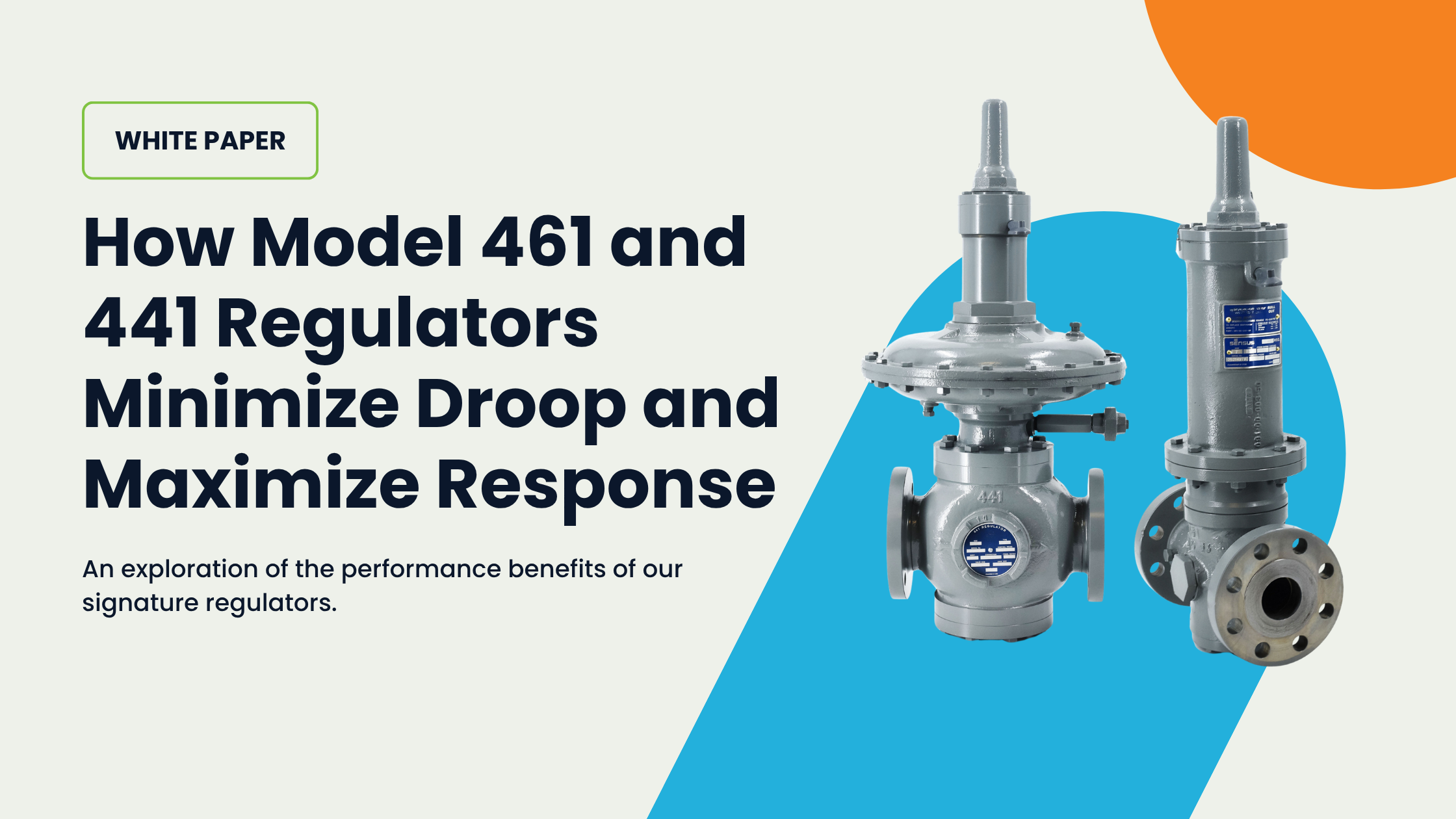
The Model 441 and Model 461 Regulators are ideal for large-capacity applications including district regulator stations, city gate stations, and industrial applications.
They come in a wide array of body and diaphragm sizes, orifice sizes, and spring options to meet any high-capacity application. The 441 has higher capacities than the 461 due to larger body and orifice sizes. The 57S and X57 models utilize the signature “roll-out diaphragm,” making them ideal for medium and high-pressure applications.
|
Model |
461-S |
441-S |
461-57S |
441-57S |
461-X57 |
441-X57 |
|
Capacity |
High |
Highest |
High |
Highest |
High |
Highest |
|
Body Size |
2” |
2”-4” |
2” |
2”-6” |
2” |
2”-3” |
|
Diaphragm |
8-12” Flat |
10-20” Flat |
Roll-Out |
Roll-Out |
Roll-Out |
Roll-Out |
|
Outlet Range |
< 10 psi |
< 6 psi |
3 – 100 psi |
3 – 100 psi |
75 – 250 psi |
75 – 250 psi |
The heart of the 57S and X57 regulators is the “roll-out” diaphragm. These are spring-loaded regulators with performance that approaches that of a pilot-operated regulator. The “roll-out” diaphragm makes this exceptional performance possible because its action reduces droop to a minimum. While these regulators have close to the setpoint accuracy of pilot-operated regulators, they have a few key advantages over pilot-operated regulators that make them ideal for regulator stations and industrial applications.
- Roll-out diaphragm on 57S and X57 models offers near pilot-operated setpoint accuracy performance
- Faster response
- Reduced risk of freezing
- Simplified maintenance and lower maintenance costs
- More reliable
Minimizing Droop
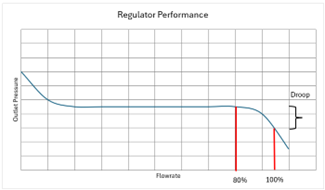
Droop is the decrease in outlet pressure as the flow of gas increases for a spring-loaded regulator. All spring-loaded regulators experience droop, and it is caused by three main effects: spring effect, body effect, and diaphragm effect.
Spring Effect
A regulator works by balancing the force of the downstream gas pushing up on the diaphragm, acting to close the valve, and the force of the spring pushing down on the diaphragm acting to open the valve. If the downstream pressure drops and the force of the spring is greater, then the valve opens. If the downstream pressure increases and is greater than the force of the spring, then the valve closes.
However, the force of the spring is not constant. The force of the spring changes, providing a slightly greater force when it is compressed compared to when it is extended. The spring effect is governed by Hooke's Law, which states that the force a spring exerts is proportional to how much it is compressed:
|
F = k * x |
Where: K = the spring constant (stiffness) X = the distance the spring is compressed |
When the regulator is set to a given downstream pressure setpoint at a low flow, the spring is compressed to a specific distance. When the gas flow increases, the downstream pressure initially drops as the spring expands to open the regulator. According to Hooke's law, as the compression distance decreases, the force of the spring also decreases. Now, the spring is pushing down with less force than it was at setpoint.
It takes less gas pressure to push back and reach a new balance because the spring is now pushing down with less force, causing the regulator to settle at a lower outlet pressure. This is the spring effect; the regulator cannot maintain the original pressure because the very act of opening the valve causes the spring to lose some of its strength.
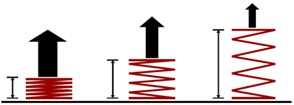
The spring effect can be mitigated by choosing a spring at the higher end of its outlet pressure range. Stiffer springs generally exhibit less droop than lighter ones.
Body Effect
There are three main causes of the body effect:
- Pressure loss due to turbulent flow through the body
- Impingement of the valve discharge on the diaphragm
- Inlet pressure acting on the underside of a valve
Pressure Loss Due to Turbulent Flow Through the Body
As gas demand increases, the gas must move faster through these tight spaces. High-velocity gas creates turbulence—swirling eddies and friction against the internal walls of the regulator body. This turbulence consumes energy and causes a decrease in pressure.
Impingement of the Valve Discharge on the Diaphragm
If the regulator is internally controlled, the gas flowing through the orifice has high velocity and slams against the diaphragm. The diaphragm will then sense a higher downstream pressure than in reality due to the high velocity of the gas exiting the orifice. Since the regulator thinks the downstream pressure is higher than it actually is, it will close the valve too soon, causing excessive droop.
External control counteracts the impingement of the valve discharge on the diaphragm and any impacts of turbulent flow in the body by sensing the gas upstream.
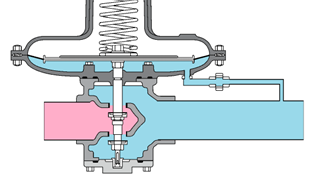
Inlet Pressure Acting on the Underside of a Valve
In unbalanced regulators, high-pressure gas can push against the bottom of a valve seat. This force pushes up on the valve stem, helping to push the valve closed. As the inlet pressure drops, there is less force pushing up on the valve stem. The spring has less resistance, so the regulator can open wider. Therefore, as the inlet pressure drops, the regulator will be able to open with less resistance, and the outlet pressure will be higher.
Double Balanced Valve Design
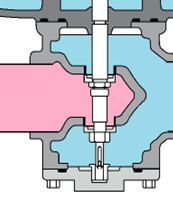
A double balanced regulator refers to a design where the valve is balanced against pressure changes on both the inlet and outlet sides. All Model 441 regulators have double balanced valves, while Model 461 regulators can contain either a single balanced valve or double balanced valves.
Double balance valves are shown in the figure below. The inlet pressure is pushing up against the top valve and down against the bottom valve, while the outlet pressure is pushing down on the top valve and up on the bottom valve. These forces all cancel each other out, eliminating the body effect of the inlet and outlet pressure acting on the valve.
Diaphragm Effect
The diaphragm effect refers to the change in the effective surface area of the diaphragm as the regulator opens and closes. The force generated by the downstream gas pressure can be expressed by:
|
F = P * A |
Where: P = downstream gas pressure A = effective area of the diaphragm |
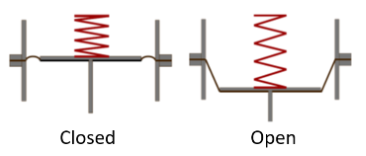
When closed, the diaphragm is usually in a flat position. As the regulator opens, the flexible diaphragm material stretches and changes its angle, increasing the surface area of the diaphragm. The diaphragm area increasing counteracts the gas pressure decreasing:
F = P ↓ A ↑
As the downstream pressure increases and the regulator closes, the flexible material contracts, decreasing the surface area of the diaphragm. The diaphragm area decreasing counteracts the gas pressure increasing:
F = P ↑ A ↓
The diaphragm effect works alongside the spring effect. As flow increases and the regulator opens, the spring loses force, and the diaphragm gains force. Both forces work together to pull the outlet pressure downward as flow increases. To minimize the diaphragm effect, a molded “roll-out” diaphragm is used on all 57S and X57 models.
Roll-Out Diaphragm
The action of the “roll-out” diaphragm differs from a conventional diaphragm in how the change in the effective area occurs. Where the effective area of a conventional diaphragm increases as the regulator opens, the “roll-out” area decreases. Conversely, where the area of the conventional diaphragm decreases during closing, the “roll-out” area increases. This greatly improves performance by practically eliminating droop.
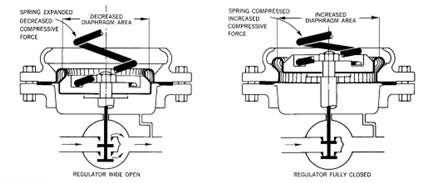
The 57S and X57 regulators provide constant pressure regulation not previously possible in medium- and high-pressure spring-loaded regulators. It approaches pilot performance and offers further advantages of simplicity, dependability, freedom from freeze-up, and exceptionally fast response.
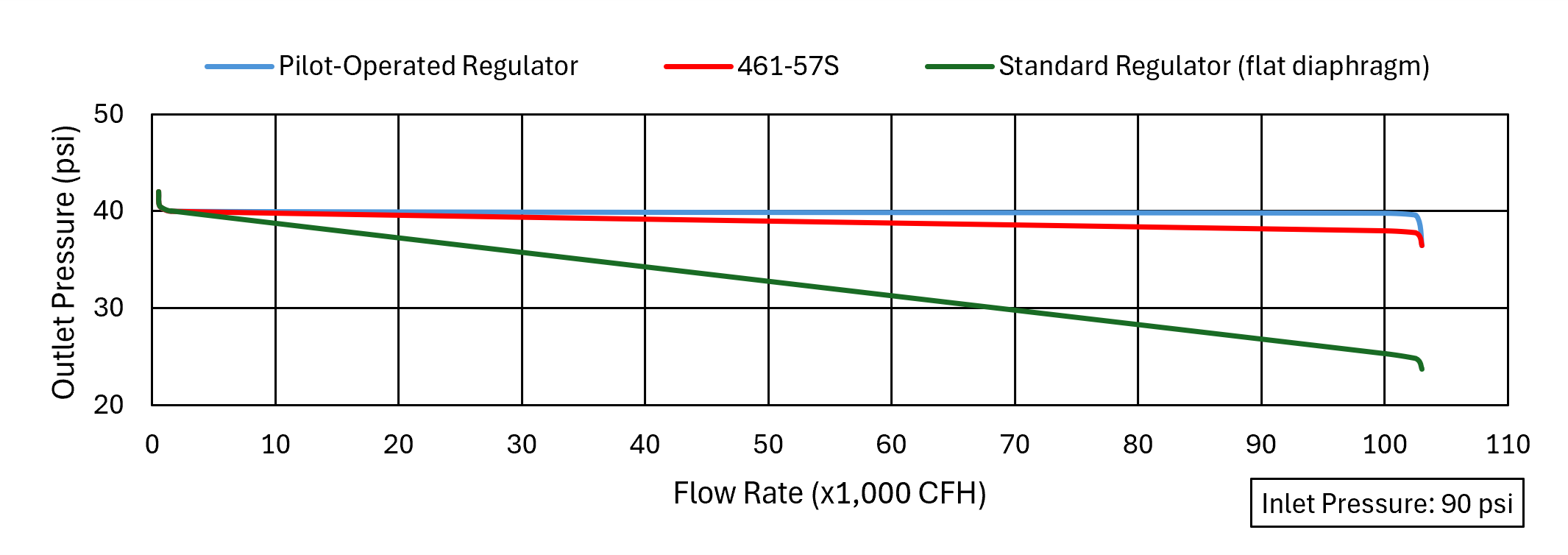
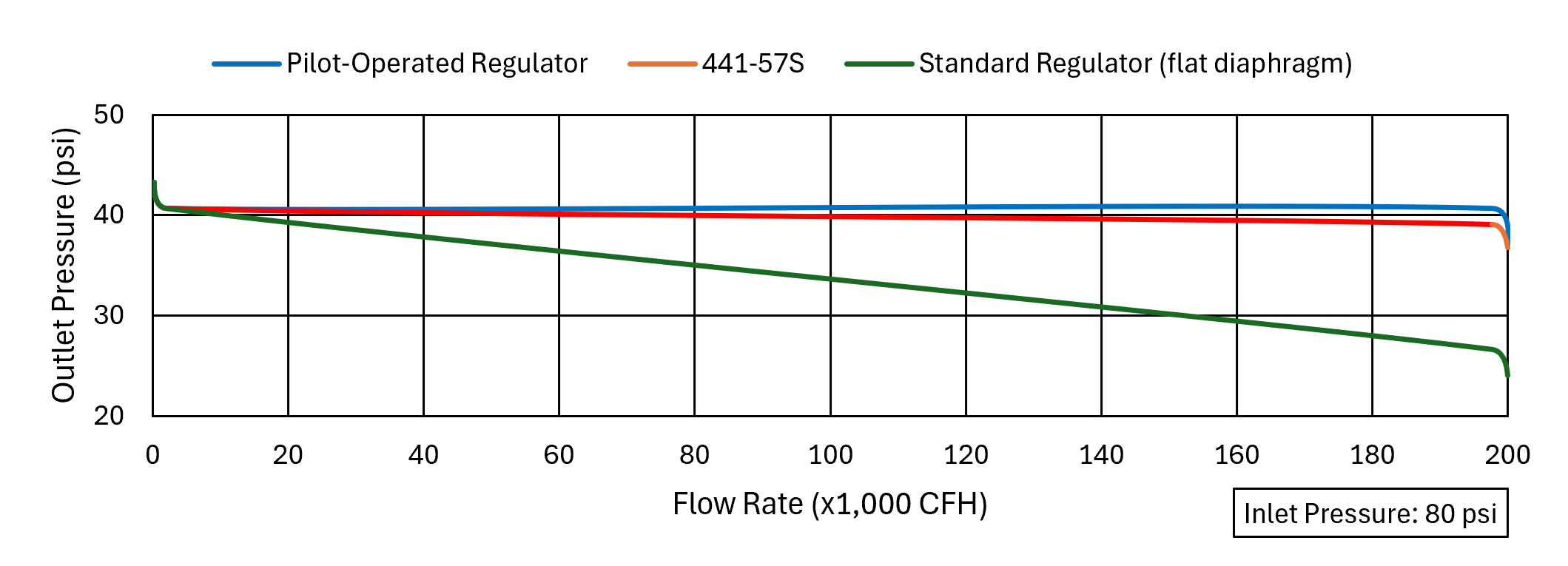
Model 441 and 461 Regulators Compared to Pilot-Operated Regulators
Fast Response
A direct-acting regulator with a roll-out diaphragm responds faster than a pilot-operated regulator primarily because it responds directly to changes in downstream pressure, while pilot-operated models have multiple physical stages to go through before the valve moves.
In a direct-acting regulator, like the 461 and 441 models, the diaphragm is physically attached to the valve stem. When the downstream pressure drops, it decreases the force on the diaphragm, and the diaphragm moves immediately. Because the diaphragm pan is physically connected to the valve stem, the valve moves at the exact same time.
In a pilot-operated regulator, the pilot senses the pressure change and must change the loading pressure, which travels through small tubing to the main diaphragm. The main diaphragm then moves the main valve, allowing more gas to flow downstream. This creates a measurable time lag that doesn’t exist with a direct-acting regulator.
Model 461 and 441 regulators are perfect to use as monitor regulators due to the fast response and exceptional performance.
Reduced Risk of Freezing
Direct-acting regulators are significantly less likely to freeze than pilot-operated regulators because they use larger orifices to restrict the flow compared to pilot-operated regulators. Because the gas is restricted through such a small space on pilot-operated regulators, it is extremely easy for a tiny drop of moisture or a small amount of hydrate to turn into ice and completely plug the pilot. If the pilot freezes, the entire regulator fails.
Direct-acting regulators use much larger orifices and while ice can still form on the main valve seat, the sheer force of the main spring and the larger clearance of the valve often allow it to crunch through or blow past small amounts of ice that would have instantly disabled a pilot. These regulators have been installed in the northern US and Canada for over 70 years and are often referred to as “ice breakers” in Canada. Direct-acting regulators are also better at handling wet or dirty gas due to using larger orifices and having fewer moving parts.
Simplified Maintenance
Direct-acting regulators are more cost effective and easier to maintain. Pilot-operated models have a main valve and pilot valve, which means there are twice as many orifices, seats, diaphragms, and seals to inspect and replace. On the other hand, direct-acting models have one large diaphragm, spring and valve assembly, and seat to inspect.
While cost of parts can vary over time, utilities we have spoken to estimate that these USG regulators are 40-60% cheaper to maintain compared to the equivalent pilot-operated models. USG regulators are simple to maintain. A complete teardown and rebuild of a Model 461 or 441 regulator can take under 20 minutes. USG has instructional YouTube videos that show how to perform all the maintenance needed here: https://www.youtube.com/@UtilitySolutionsGroup-1
More Reliable
The biggest reliability risk in a regulator is losing the signal that tells the valve to open or close. Model 461 and 441 regulators use a single external sense line that must be kept open and clear of debris. On the other hand, pilot-operated regulators have multiple small lines that are used to sense upstream/downstream pressure and send the loading pressure from the pilot regulator to the main regulator. Using additional small lines creates more points of failure.
USG regulators typically stay in service for decades. Utilities frequently keep these installed for 40+ years, and USG has found multiple regulators under their previous brand names that have been in the field for over 60 years.
Conclusion
The Model 441 and 461 regulators, particularly those equipped with the "roll-out" diaphragm (57S and X57 models), offer a high-performance alternative to pilot-operated regulators for large-capacity applications. By fundamentally redesigning the diaphragm's movement to counteract the traditional diaphragm effect, these direct-acting regulators achieve an exceptional level of performance nearly eliminating droop. In addition, these models provide several critical operational advantages, including faster response speed, superior reliability, and simplified design and maintenance compared to pilot-operated models.
With a proven track record spanning over 70 years under various brand names, the Model 441 and 461 series continue to provide a dependable, simple, and high-speed solution for district stations, city gates, and industrial gas applications.